
How Reverse Osmosis Water Systems Work (Simple Guide) Reverse osmosis (RO) is a water purification method designed to remove a wide range of dissolved substances—like salts, many heavy metals, and many contaminants—from tap water. While RO systems may look complex, the core idea is straightforward: force water through a special filter that only allows certain molecules to pass. An RO system typically combines several filtration steps. These stages protect the membrane, improve water quality, and help ensure the process runs efficiently. The exact setup varies by model, but most systems follow the same general flow. Step 1: Pretreatment to protect the membrane Before raw water reaches the RO membrane, it usually passes through a prefilter stage. Common pretreatment includes a sediment filter to remove sand, rust, and other particles, and sometimes an activated carbon filter to reduce chlorine taste and odor. This matters because chlorine and fine debris ...
How Reverse Osmosis Water Systems Work (Simple Guide)
Reverse osmosis (RO) is a water purification method designed to remove a wide range of dissolved substances—like salts, many heavy metals, and many contaminants—from tap water. While RO systems may look complex, the core idea is straightforward: force water through a special filter that only allows certain molecules to pass.
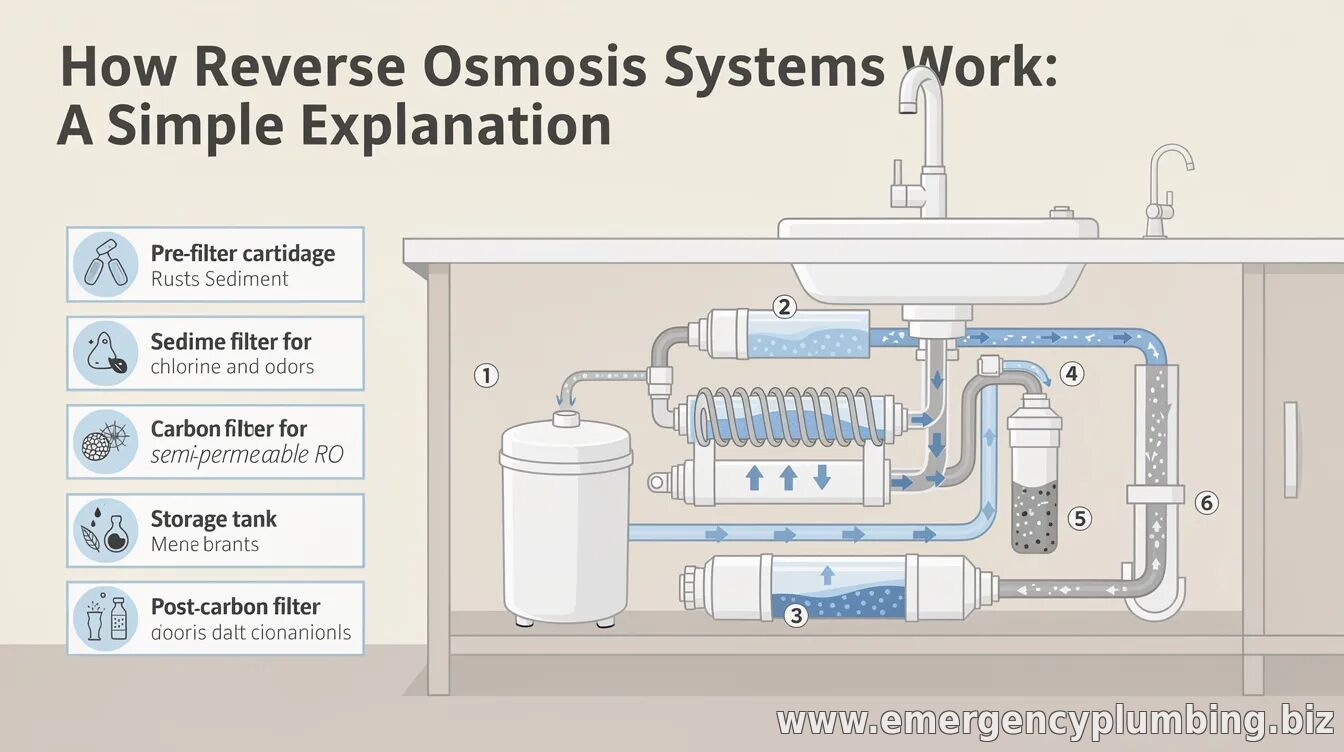
An RO system typically combines several filtration steps. These stages protect the membrane, improve water quality, and help ensure the process runs efficiently. The exact setup varies by model, but most systems follow the same general flow.
Step 1: Pretreatment to protect the membrane
Before raw water reaches the RO membrane, it usually passes through a prefilter stage. Common pretreatment includes a sediment filter to remove sand, rust, and other particles, and sometimes an activated carbon filter to reduce chlorine taste and odor. This matters because chlorine and fine debris ... Read more »
Comments
Post a Comment